Home >
We advocate for policies that grow our state’s life science industry.
In this fast-moving industry, BioCT keeps policy makers and influencers abreast of the latest developments and changing needs of the life science community.
Advocacy & Government Affairs
Our mission is to provide education and advocacy for Connecticut’s bioscience and life science communities at the policy level and ensure synergy of action and alignment of state and federal initiatives that have a significant impact on our members. Learn more about BioCT.
2026 Legislative Agenda
The 2026 session of the CT General Assembly is underway, and BioCT is working to ensure Connecticut remains economically competitive for the life sciences industry. Below are the key points from BioCT’s Legislative Agenda.
Ensure a Competitive Policy & Fiscal Environment for Life Sciences Talent and Companies
- Reduce the Consulting Tax for the Biotech Industry
- Increase Non-incremental Credit to 15%
- Allow Biotech Companies to Sell/Exchange Net Operating Losses (NOLS)
- Create New Jobs Credit to Biotech Companies
- Enhance Competitiveness of the Angel Investor Tax Credit Program
- Include Electricity in CERT-129 Regulations
- Support Transportation Infrastructure Improvements
- Ensure Artificial Intelligence (AI) Legislation and Policy Supports Patients and Supports Innovation
- Ensure CT is Competitive with Neighboring States
- Protect CT Life Sciences in the Face of Federal Challenges
Patient Benefits and Access
- Maintain the integrity of the Federal 340B program, which is intended to ensure underserved minority communities have access to affordable medicines
- Oppose the Creation of Pharmaceutical Drug Affordability Board (PDAB)
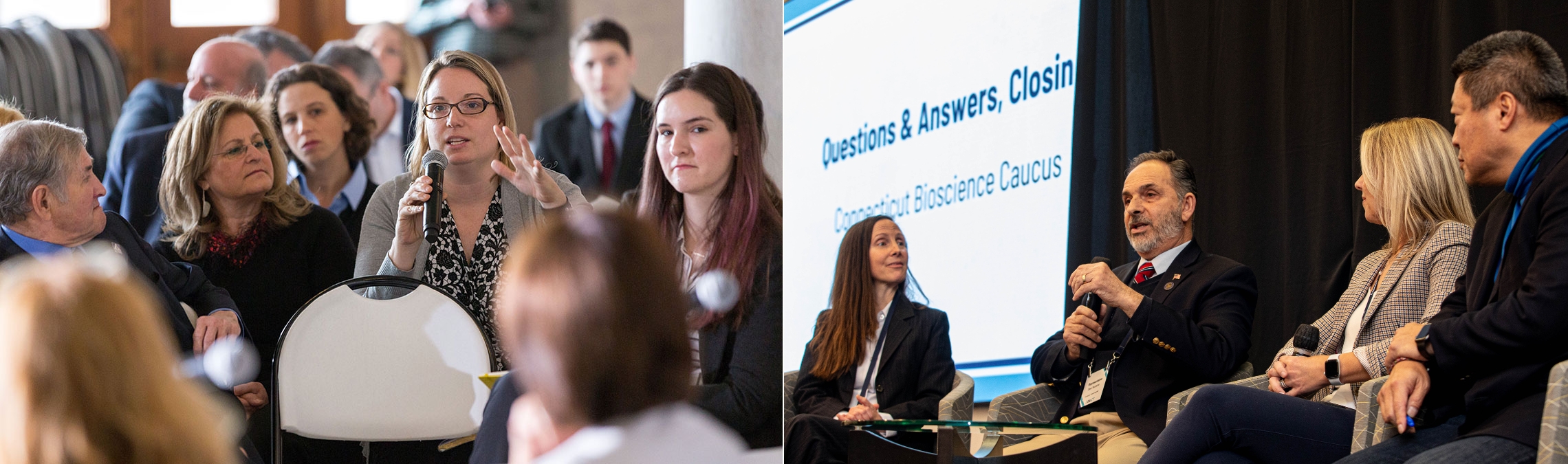
Annual Legislative Breakfast
WATCH NOW:
BioCT’s Legislative Breakfast Meeting
Recorded: 1/26/2026

Press coverage:
- Jan 27: BriefGlance.com: Connecticut’s Biotech Sector Unites Against Federal Headwinds
- Jan 27: Yale Daily News: A senator, the governor and biotech leaders discuss industry issues
- Jan 27: Business Wire: BioCT Brings Legislators, Academia, and Industry Leaders Together to Strengthen Connecticut’s Life Sciences Sector Ahead of 2026 Session
- Jan 26: New Haven Register: CT biotech industry seeks new tax breaks as competition heats up
- Jan 26: CT Insider: CT biotech industry seeks new tax breaks as competition heats up
- Jan 26: Hartford Business Journal: With federal funding uncertain, BioCT urges CT to adopt tax incentives, innovation policies for life sciences industry
- Jan 26: CT-N: BioCT Annual 2026 Legislative Breakfast Meeting
Opinion Articles
May 1, 2026 • Hartford Business Journal
Legislative proposal threatens CT’s life sciences sector, patient access to critical medicines
February 5, 2026 • LinkedIn
Comments on Governor Ned Lamont’s State of the State Address
2026 Testimony and Issues of Interest
SB 84 — An Act Concerning Revenue Items to Implement the Governor’s Budget
March 11, 2026 | Testimony Submitted to the Insurance and Real Estate Committee
BioCT testimony in support of Section 5 of Senate Bill 84, advocating important changes to Connecticut’s Research and Development (R&D) tax credit by allowing pass-through entities with a maximum size to earn such credits.
HB 5443 — An Act Concerning the Sales and Use Taxes Rate for and Applicability to Certain Motor Vehicles, Peer-to-Peer Car Sharing, Certain Personal Property Used in Burials and Cremations and Electricity for Biotechnology Businesses, dedicating Funding for the Tourism Fund and Increasing the Exemption Amount for Sales Tax-Free Week
March 11, 2026 | Testimony Submitted to the Finance, Revenue, and Bonding Committee
BioCT testimony in support of Section 4 of HB 5443, which exempts electricity used by biotechnology businesses from sales and use taxes.
SB 450 — An Act Concerning the Standard of Care for Immunization
March 10, 2026 | Testimony Submitted to the Public Health Committee
Biotechnology Innovation Organization (BIO) and BioCT testimony sharing comments and suggested language changes for Senate Bill 450 to ensure product availability, access, and choice are not unintentionally limited for Connecticut residents.
SB 314 — An Act Concerning the Protection of Animals Used in Certain Research
March 4, 2026 | Testimony Submitted to the Environment Committee
BioCT testimony in opposition of Senate Bill 314, noting that while the bill is well-intentioned, it is unnecessary, duplicative of existing federal protections, and could unintentionally restrict critical biomedical research that benefits both humans and animals.
SB 342 — An Act Concerning Health coverage
March 3, 2026 | Testimony Submitted to the Insurance and Real Estate Committee
BioCT testimony in support of Section 4 of Senate Bill 342, prohibiting the automatic downcoding or denial of health insurance claims without clinical peer review.
SB 237 — An Act Concerning Public Transportation
March 2, 2026 | Testimony Submitted to the Transportation Committee
BioCT testimony in support of Senate Bill 237, advocating for the Connecticut Department of Transportation to restore Shore Line East regional rail service to the same level as existed prior to the reduction in service due to the COVID-19 public health emergency and the civil preparedness emergency declared by the Governor on March 10, 2020.
HB 5244 — An Act Concerning the Department of Economic Development and Community Development’s Recommendations Regarding the Agency Financial Assistance Cap and Employment of Promissory Notes
February 24, 2026 | Testimony Submitted to the Commerce Committee
BioCT testimony in support of HB 5244, advocating for the modification of regulations surrounding employment promissory notes by clarifying that employers cannot require employees to sign such notes as a condition of employment, rendering any such agreements void.
Previous Years
2025 BioCT Legislative session report
2025 BioCT Legislative agenda
SB 1246 — An Act Concerning Revenue Items to Implement the Governor’s Budget
February 26, 2025 | Testimony Before the Finance Revenue and Bonding Committeee
BioCT testimony in support of Senate Bill 1246, advocating for an increased R&D tax credit exchange rate, inclusion of non-corporate entities, and an accelerated Capital Base Tax phase-out to strengthen Connecticut’s life sciences industry.
SB 714 — An Act Restoring Service on the Shore Line East Rail Line
February 26, 2025 | Testimony Submitted to the Transportation Committee
BioCT testimony in support of Senate Bill 714, advocating for the restoration of Shore Line East rail service to pre-pandemic levels to strengthen Connecticut’s life sciences industry by improving transportation access, attracting talent, and fostering economic growth.
HB 6870 — An Act Addressing Patients’ Prescription Drug Costs
February 18, 2025 | Testimony Submitted to the Insurance and Real Estate Committee
BioCT testimony on HB 6870 raises concerns that the bill could deter investment, hinder innovation, and create a negative regulatory environment for the life sciences industry in Connecticut. BioCT emphasizes the importance of balancing patient access to affordable medicines while fostering industry growth and protecting pharmaceutical safety standards.
2024 Public Policy Report Card
2024 BioCT Legislative agenda
2024 BioCT Legislative Summary
Roberta Willis Scholarship Program
Testimony for the Appropriations Committee
BioCT testimony supports increased funding for the Roberta Willis Scholarship Program, highlighting the state’s low investment in student grant aid and the growing disparities in college enrollment, especially among low-income and minority students. BioCT urges support for funding increases to improve access to higher education and promote a highly trained workforce.
SB 379 – An Act Increasing The Rate Of The Credit Refund Value For Certain Expenditures By Biotechnology Companies
March 14, 2024 | Testimony Submitted to the Commerce Committee
BioCT testimony in support of SB 379 urges increasing the R&D tax credit refund to keep Connecticut competitive in life sciences. Similar investments in neighboring states have driven growth, and enhancing this credit will attract biotech companies, spur innovation, and create jobs. BioCT strongly supports SB 379 to strengthen the state’s economy.
SB 307 – An Act Concerning Medicaid Coverage Of Biomarker Testing
March 12, 2024 | Testimony Submitted to the Human Services Committee
BioCT testimony in support of SB 307 urges Medicaid coverage for biomarker testing, a critical tool for precision medicine that improves treatment effectiveness and patient outcomes. This bill ensures Medicaid enrollees have access to the same scientific advancements as those with private insurance, reducing disparities and optimizing care.
SB 8 – AAC Drug Affordability
March 12, 2024 | Testimony Submitted to the Human Services Committee
BioCT testimony opposes SB 8, citing concerns that setting pharmaceutical prices could hinder life science innovation, limit pharmacy options, and deter investment in Connecticut’s growing biotechnology sector. BioCT urges policymakers to consider the negative impact on patient access and scientific progress.
HB 5367 – AN ACT CONCERNING MEDICAID COVERAGE OF RAPID WHOLE GENOME SEQUENCING FOR CRITICALLY ILL INFANT
March 7, 2024 | Testimony Submitted to the Human Services Committee
BioCT testimony supports H.B. 5367, which expands Medicaid coverage for rapid whole genome sequencing for critically ill infants. BioCT emphasizes that this tool significantly shortens diagnostic times for rare diseases and reduces costs, advocating for its broader use to improve patient outcomes without overburdening the Medicaid program.
SB 277 – AN ACT RESTORING SERVICES ON THE SHORE LINE EAST RAIL LINe
March 4, 2024 | Testimony Submitted to the Transportation Committee
BioCT testimony in support of SB 277 urges the restoration of Shore Line East rail service to pre-pandemic levels. Reliable transportation is essential for Connecticut’s life sciences industry, supporting workforce retention, business growth, and economic strength.
HB 5054 – AN ACT ADDRESSING HEALTH CARE AFFORDABILITY
February 27, 2024 | Testimony Submitted to the Insurance and Real Estate Committee
BioCT testimony opposes H.B. 5054, which proposes the establishment of a Prescription Drug Advisory Board to review drug costs and recommend affordability strategies. BioCT argues that imposing price controls on biopharmaceutical products would reduce incentives for innovation, harm Connecticut’s biopharmaceutical sector, and limit access to new therapies, ultimately damaging both the industry and the state’s economy.
2023 BioCT Legislative agenda
Join Bill 5014 – an act concerning the cap on research and development tax credits
February 27, 2023
BioCT respectfully requested that the committee amend the bill to: (1) increase the cash exchange rate for biotechnology companies from 65 percent to 100 percent; (2) increase the R&D tax credit rate from 70 percent to 100 percent for biotechnology businesses; and (3) expand the R&D tax credit to include biotechnology S Corporations and LLCs.